
Home / Industries / Farming & Soil Carbon
Build crop performance from the root zone outward. Bloom Grow brings biological support into field crops, orchards and forage programs, with attention to nutrient use, crop establishment, soil condition and the value of the harvested crop.
Explore the product details or choose an application below.
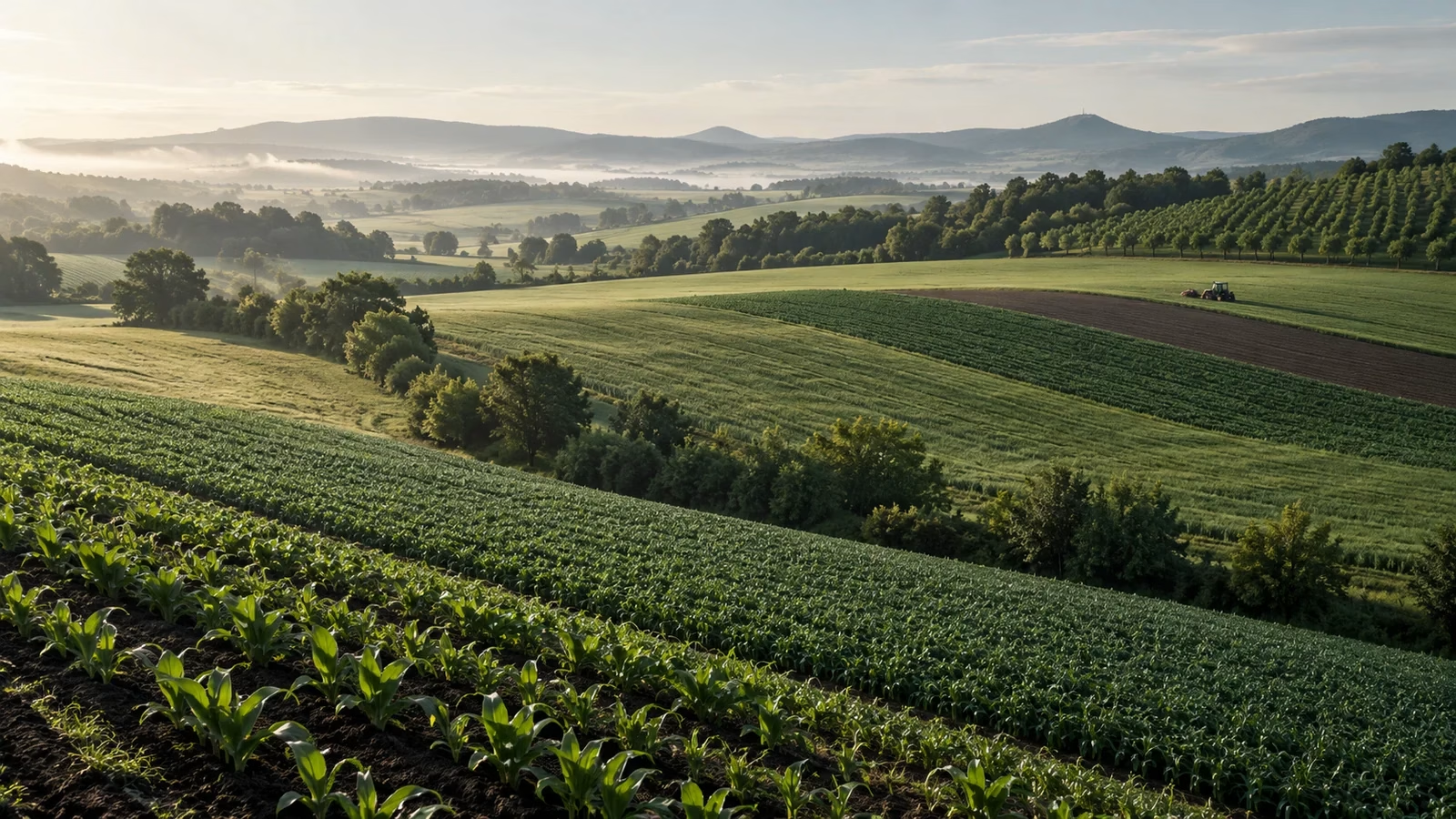
Illustrative environment · Field crops
When crop prices constrain margins, improving the return from fertilizer, water and each planted hectare matters. Uneven establishment, weak root development and declining soil performance can erode that return.
Use Bloom Grow within a crop-stage program informed by soil condition, fertilizer history, irrigation and harvest objectives. Start with a comparable field area and keep clear records of the inputs used.
The crop guides cover maize, soybeans, wheat, barley and sorghum. Match the program to establishment, active growth and the crop’s current fertility plan; no single percentage response applies across these crops.
The soybean literature focuses on the root zone, nodulation and nutrient uptake. In a field evaluation, document nodulation, canopy development and harvested grain rather than assuming a fixed nitrogen contribution or protein gain.
For cane, the materials emphasize post-harvest residues, ratoon growth and nutrient cycling. Vinasse reuse requires a defined nutrient and salinity balance; evaluate it as an agronomic input with the relevant site requirements.
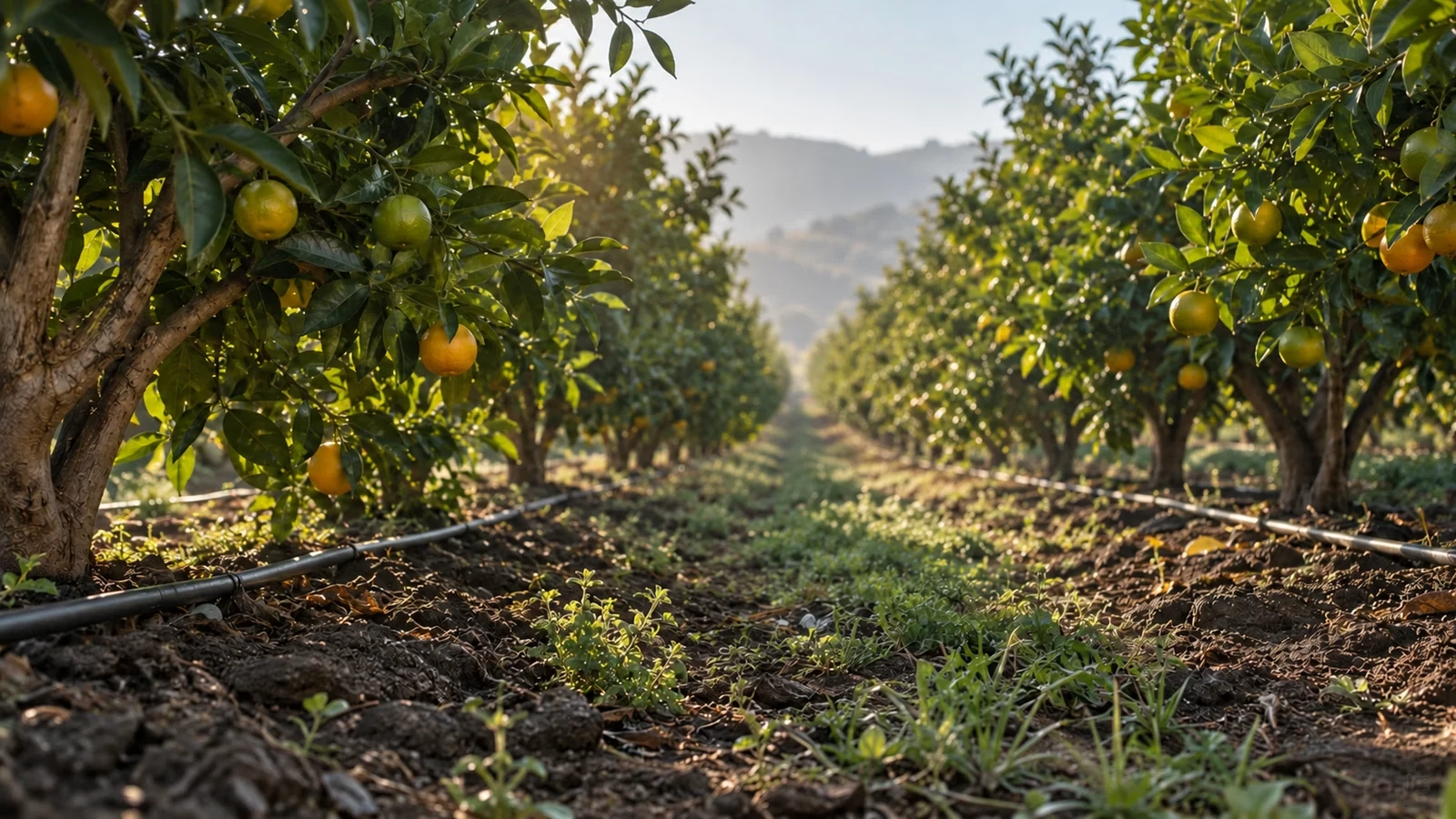
Illustrative environment · Orchards & horticulture
Perennial root zones must sustain repeated harvests, while high-value produce must meet market requirements for size, uniformity and quality. Increasing fertilizer alone may not address the biological part of that system.
Build a root-zone and crop-stage program for the orchard or horticultural crop. Use soil and leaf analysis alongside yield and grading records to connect biological support with commercial outcomes.
Citrus, apples, avocados, almonds and vineyards appear in the reviewed application literature. Plan around irrigation footprint, tree density, growth stage and the area actually treated.
Cucumber, tomato, pepper and other horticultural systems offer clearly measurable yield and grading endpoints. The strongest supplied controlled crop study concerns soil-grown cucumber with Ergofito Universal; it is described separately in the evidence section.
The citrus report combines reduced fertilizer, humic/fulvic material and Ergofito Universal Biology. It is useful program evidence, but it cannot isolate the contribution of current Bloom Grow.
A measurable plant-biomass response ↗ — see the Science & Results section for the original reference.

Illustrative environment · Pasture & forage
Repeated cutting or grazing places a premium on dependable regrowth, useful dry matter and sensible fertilizer expenditure. Soil condition and root density are part of sustaining that productivity.
Coordinate Bloom Grow with the cutting or grazing cycle, using a defined forage area and an agreed nutrition plan. Measure regrowth and feed quality before drawing conclusions about carrying capacity or animal output.
The pasture brochure describes post-cut and post-grazing applications. Final timing and quantity depend on crop, soil, moisture and the approved formulation protocol.
Use dry matter and laboratory feed-quality measures where available. Fresh weight or visual greenness alone can give an incomplete picture of the feed produced.
Compare the extra usable forage with product and application costs. Claims about milk, meat or carrying capacity need their own measured animal-production context.
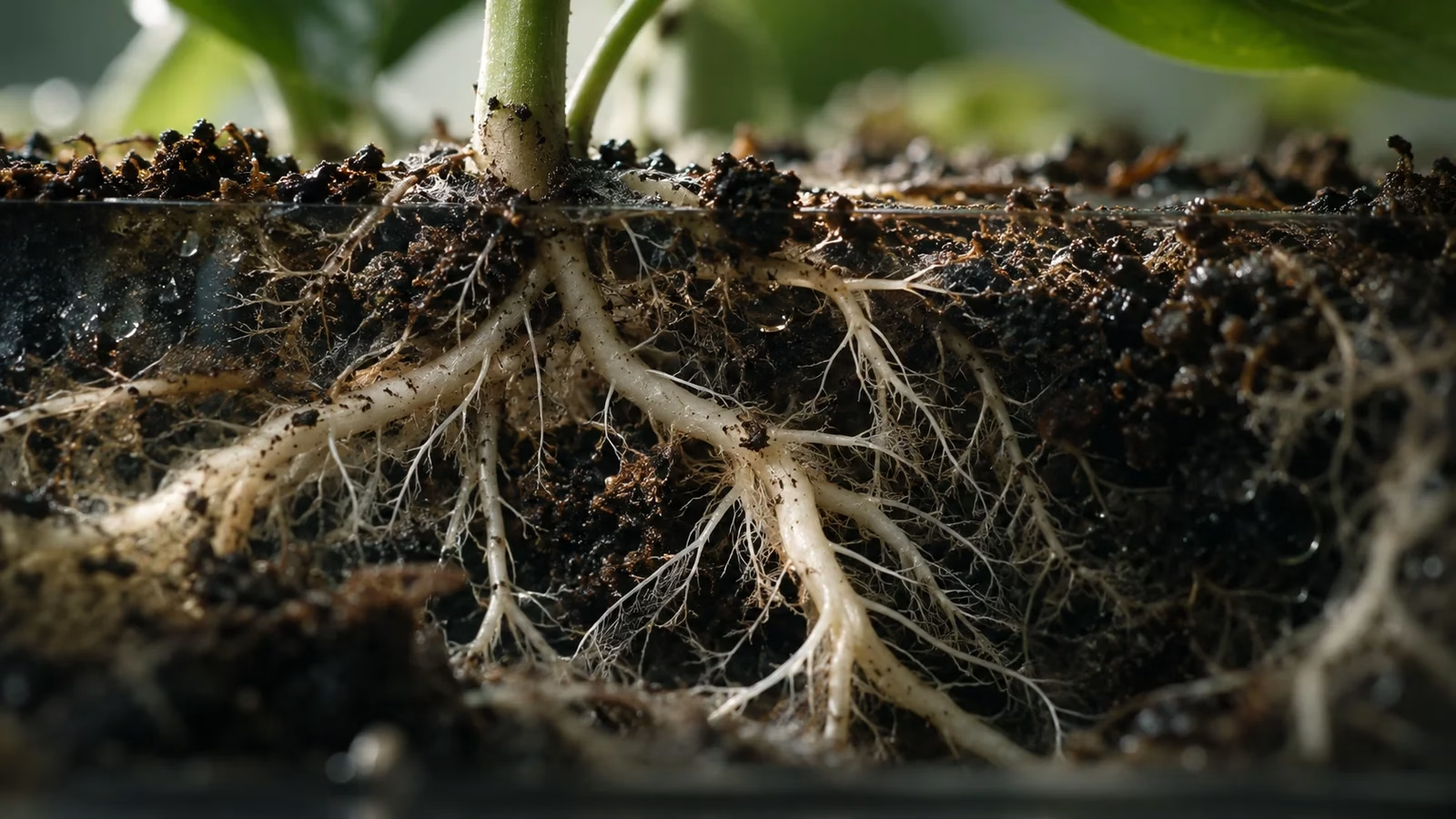
Illustrative environment · Soil carbon
A healthier-looking crop or a higher soil-carbon concentration does not on its own establish a carbon-removal rate. Growers need a consistent baseline and a method that distinguishes soil improvement from a creditable climate outcome.
Treat Bloom Carbon as a measurement-led program alongside agronomy. Establish the field boundary, depth, soil mass assumptions, treatment footprint and repeat-measurement plan before estimating a change in carbon stock.
Root-zone activity, residue management and organic matter are part of the agronomic program. Record these changes separately from greenhouse-gas calculations.
A concentration is the proportion of carbon in soil. A stock estimate also needs soil mass and a defined area and depth. A rate requires measured change over a stated time period; it cannot be inferred from a single stock figure.
A laboratory report supports the measurements it contains. Credit issuance requires an applicable methodology, baseline, additionality, permanence and verification; no credit yield or revenue is promised by the material reviewed here.
The program starts with the outcome you need to improve. The measures keep that objective visible.
Support nutrient availability and root-zone activity while measuring crop output against actual inputs. Fertilizer efficiency is a crop-specific agronomic objective, assessed through performance and soil or tissue analysis.
Company and supplier materials emphasize feeder-root development and crop vigor. Evaluate these changes alongside stand uniformity, harvestable yield and the quality characteristics that influence value.
Crop residues and suitable organic inputs are part of the soil program. Biological conversion can support nutrient cycling and organic-matter development when combined with sound moisture, residue and fertility management.
Measure yield, grade and input costs together. Soil carbon is a separate measurement pathway that can add understanding of long-term soil change; it should not replace the immediate farm-performance case.
The rhizosphere is the living zone around plant roots. Bloom’s agricultural materials describe microbial and enzymatic processes intended to support nutrient availability and root development in this zone.
Supplier guides describe conversion of organic material and mobilization of nutrients around roots. The crop program still accounts for soil fertility, irrigation and the nutrients removed in the harvest.
Track organic matter, root development, crop response and inputs over time. Where a carbon objective is included, define a baseline and consistent measurement approach before making removal claims.
Reported results belong to the conditions in which they were measured. Explore the source notes to understand how each finding relates to your application.
of standard nutrition in the T3 study group
In a Tecnova cucumber study of Ergofito Universal, final mean commercial fruit yield was 5.764 kg/m² in T3 versus 4.379 kg/m² in the control. The difference was numerical, not statistically significant.
Tecnova, Almería, Spain; soil-grown Valle cucumber,2022 crop cycle, report January 2023. Three repetitions per treatment. Product: Ergofito Universal.
Not microgreens data. The study product is named Ergofito Universal; equivalence to current Bloom Grow/C2E is not established by the report. Do not generalize to all crops or prescribe a fertilizer reduction from this result.
grams of total dry biomass per plant: T3 and control
The Tecnova cucumber study of Ergofito Universal shows statistically distinct total dry-biomass groups for T3 and the control. This measures dry plant biomass, not marketable fresh crop yield.
Tecnova report, PDF page 27, Table 18. T3 used 70% nutrition plus Ergofito Universal; control used 100% nutrition without the product.
Crop-, formulation- and study-specific. This outcome does not substantiate a 25% microgreens-yield claim.
fertilizer reduction included in the reported program
The Eureka lemon report describes two applications alongside humic/fulvic material, with soil and leaf analysis and observations of carbon and organic matter.
Sundays River Valley; report January 2024; Ergofito Universal Biology and humic/fulvic inputs.
A multi-input program with no demonstrated equivalence to current C2E. The report is not a standalone product-effect estimate or a verified annual carbon-removal calculation.
A Tecnova greenhouse cucumber study included Ergofito Universal with 70% of the standard nutritional program. That group had higher mean commercial yield, but the yield difference was not statistically significant. This supports further work on nutrient efficiency in that context; it is not an automatic 30% reduction instruction for every crop or the current Bloom Grow formulation.
Bloom Grow is the agricultural product used within a crop and soil program. Bloom Carbon is the separate pathway for assessing measured climate outcomes. Buying or applying the product does not itself establish verified carbon credits.
Reviewed materials describe crop-specific soil, irrigation, fertigation and foliar approaches. Confirm the delivered formulation, crop stage, tank mix, water quality and application equipment before setting a protocol. Historical rates for Ergo Plus, Ergofito Universal or seed formulations should not be transferred directly.
Start with the farm’s commercial objective: saleable yield, grade, regrowth or input cost. Add soil and tissue analysis where useful. A comparison with consistent crop management helps separate a product response from differences in weather, irrigation, fertility or field condition.
The supplied citrus report and addendum describe soil observations and carbon calculations, but they do not establish a publishable annual removal rate for the current product. A complete calculation needs underlying records, a consistent soil-stock method and independent review.
The website describes root-zone and crop-performance support. Older supplier materials contain disease statements, but the reviewed package does not establish the current product’s authorized disease uses and crop-specific efficacy. Existing crop-protection and agronomic programs remain part of the farm’s management plan.
Share the application, current conditions and the problem that matters most. We identify the relevant product and technical information.
Agree the application, baseline, protocol, responsibilities and commercial terms around a defined operating objective.
Review the relevant performance and operating data, then determine whether the result supports a broader deployment.
Start with the operating challenge. We’ll connect you with the relevant product, application and next technical discussion.